
Math Enhancers


NCTM Data Analysis and Probability Standard for Grades Pre-K–2
Formulate questions that can be addressed with data and collect, organize, and display relevant data to answer them
Select and use appropriate statistical methods to analyze data

NCTM Measurement Standard for Grades Pre-K–2
Understand measurable attributes of objects and the units, systems, and processes of measurement

NCTM Number and Operations Standard for Grades Pre-K–2
Understand meanings of operations and how they relate to one another

NCTM Number and Operations Standard for Grades Pre-K–2
Understand numbers, ways of representing numbers, relationships among numbers, and number systems

NCTM Number and Operations Standard for Grades Pre-K–2
Understand numbers, ways of representing numbers, relationships among numbers, and number systems • count with understanding and recognize "how many" in sets of objects;

NCTM Algebra Standard for Grades 3-5 Understand Patterns, Relations, and Functions

NCTM Data Analysis and Probability Standard for Grades 3–5 Understand and apply basic concepts of probability

NCTM Data Analysis and Probability Standard for Grades 3–5 Understand and apply basic concepts of probability

NCTM Data Analysis and Probability Standard for Grades 3–5
Formulate questions that can be addressed with data and collect, organize, and display relevant data to answer them

NCTM Geometry Standard for Grades 3–5 Apply transformations and use symmetry to analyze mathematical situations


NCTM Geometry Standard for Grades 3–5
Analyze characteristics and properties of two- and three-dimensional geometric shapes and develop mathematical arguments about geometric relationships Use visualization, spatial reasoning, and geometric modeling to solve problems

NCTM Measurement Standard for Grades 3–5
Understand measurable attributes of objects and the units, systems, and processes of measurement

NCTM Measurement Standard for Grades 3–5
Apply appropriate techniques, tools, and formulas to determine measurements

NCTM Number and Operations Standard for Grades 3–5
Compute fluently and make reasonable estimates

NCTM Number and Operations Standard for Grades 3–5
Compute fluently and make reasonable estimates

Number and Operations Standard for Grades 3-5
Understand numbers, ways of representing numbers, relationships among numbers, and number systems
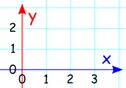
Analyzing Change Standards Grade s 6-8
Identify and describe situations with constant or varying rates of change, and compare them.
Use technology to analyze change; e.g., use computer applications or graphing calculators to display and interpret rate of change.
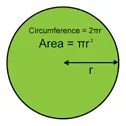
Geometry Standard Grades 6-8
Know the formulas for the area and circumference of a circle and use them to solve problems; give an informal derivation of the relationship between the circumference and area of a circle.

Pi and Circumference of a Circle


Data Analysis Standards 6-8
Discuss and understand the correspondence between data sets and their graphical representations, especially histograms, stem-and-leaf plots, box plots, and scatterplots.
Use observations about differences between two or more samples to make conjectures about the populations from which the samples were taken.
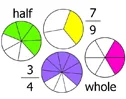
Fractions Standard for Grades 6-8
Work flexibly with fractions to solve problems. Compare and order fractions efficiently and find their approximate locations on a number line.
Multiplying and Dividing Fractions

Decimals Standard for Grades 6-8
Work flexibly with fractions, decimals, and percents to solve problems.
Develop meaning for percents greater than 100 and less than 1.
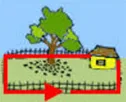
Perimeter Standards for Grade 3
Solve real world and mathematical problems involving perimeters of polygons, including finding the perimeter given the side lengths, finding an unknown side length, and exhibiting rectangles with the same perimeter and different areas or with the same area and different perimeters.
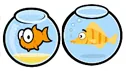
Proportional Reasoning Standards Grades 6-8
Compute unit rates associated with ratios of fractions, including ratios of lengths, areas and other quantities measured in like or different units.
Recognize and represent proportional relationships between quantities.
Develop, analyze, and explain methods for solving problems involving proportions, such as scaling and finding equivalent ratios..
A Maths Dictionary for Kids 2008 by Jenny Eather. This is a wonderful visual dictionary with many interactive illustrations. It is highly recommended for students and teachers.